
How Business Schools Can Meet ACBSP Criterion 4


Your institution’s business program may already assess student learning, but how do you show that your assessments are leading to continuous improvement?
To meet ACBSP Criterion 4, business schools need a consistent process for defining learning outcomes, measuring student achievement, analyzing results, and documenting how those findings inform improvement. Reviewing performance in later assessment cycles helps evaluate whether actions had the intended effect.
For many business programs up for ACBSP accreditation or reaffirmation, Criterion 4 is where accreditation can become challenging. Faculty may already have years of assessment data, but the challenge is showing how that information has informed decisions about the program and supported student learning.
Having an effective and repeatable assessment strategy helps make the connection clear. Learning outcomes establish what the program expects students to know, assessment results provide evidence of student achievement, and continued evaluation can show how the program has responded to what it learned. Together, these steps create a record of student learning and the decisions made to support continuous improvement.
Understanding ACBSP Criterion 4
ACBSP Criterion 4 emphasizes a systematic approach to measuring student learning and using assessment results to improve the academic quality of the program. To meet these expectations, institutions are expected to:
- Define clear and measurable learning outcomes.
- Collect direct evidence of student achievement.
- Benchmark results where appropriate.
- Demonstrate continuous improvement over multiple assessment cycles.
The strength of an assessment process comes from the connections between these steps. Learning outcomes should inform what is measured, assessment results should help faculty identify areas worth examining, and those findings should contribute to decisions about the curriculum or assessment process.
Connecting Learning Outcomes to Assessments
Before faculty can draw meaningful conclusions from the assessment, they need to know that their assessments are measuring the learning outcomes they intend to evaluate. Using curriculum mapping to connect learning outcomes to assessment topics can help create that connection.
Doing this can uncover gaps that may otherwise be difficult to see. For example, a learning outcome may appear in the program's assessment plan but have no clear measure associated with it, while another outcome may be assessed more extensively. Curriculum mapping gives faculty a clearer view of these relationships and can help ensure that the evidence they collect corresponds to the outcomes they have established.
Aligning these together also makes assessment data more useful for the faculty. With a clear link between their program and the data in the results, they can more easily find strengths and possible knowledge gaps in the program.
Assessment–Accreditor Alignment Guide
Understand how Peregrine’s Business Administration Assessment maps to the expectations of leading accrediting bodies. This concise guide helps you connect Peregrine’s assessment solutions to the standards your program is working to meet, so you can evaluate options and move ahead with clarity.
Turning Assessment Results into Useful Evidence
Collecting results and demonstrating improvement are two different things. A program may have several years of assessment data, but Criterion 4 focuses on what institutions learn from those results and how they respond.
When results reveal an area that warrants attention, faculty can examine the data more closely to understand what may be contributing to it. Comparing outcomes across assessment cycles or relevant student groups can provide additional context, while reviewing the curriculum can help determine where students encounter and develop the knowledge or skills being measured.
The findings can then inform decisions about curriculum, instruction, or assessment practices. Repeating the assessment each year give faculty an opportunity to evaluate whether those decisions had the intended effect and determine whether additional action is necessary. This is the distinction between simply reporting results and using assessment to support continuous improvement.
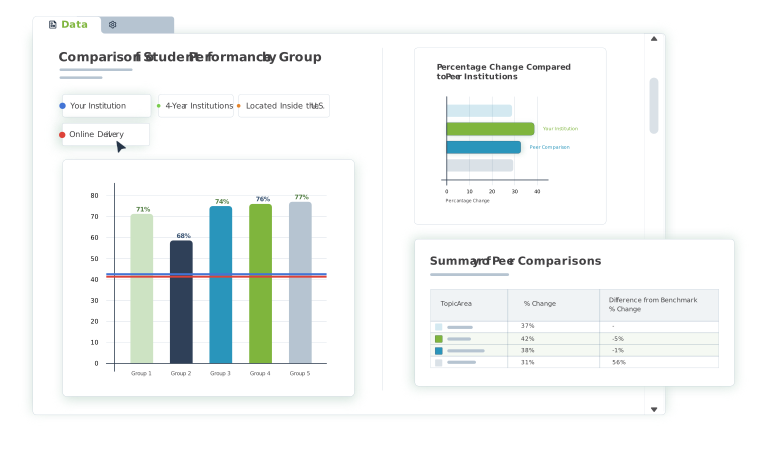
Peregrine's assessments and reporting provide direct and indirect evidence within that process. Our reports help institutions track results over time, break down their data to compare performance across programs or student groups, and benchmark against aggregated results from similar institutions.
Using Benchmarking to Add Context
Oftentimes, assessment results can be difficult to interpret without an appropriate point of comparison. A particular score may look encouraging or concerning on its own, but additional context can help faculty better understand what the result represents.
Internal benchmarking can help reveal differences across programs, campuses, cohorts, or delivery methods. External benchmarking can provide another perspective by allowing institutions to consider their performance alongside relevant aggregate or peer comparison groups. The purpose isn't necessarily to outperform another group, but to give faculty more information for interpreting their own findings.
Benchmarking is most useful when it leads to a better understanding of the strengths and weak areas of the program. Peregrine's reports provide internal and external comparison data that lets faculty see the results in a different light. These comparisons serve as a starting point for identifying opportunities for improvement and determining where further analysis may be useful.
Closing the Loop Through Continuous Improvement
One of the most important parts of the Criterion 4 process is "closing the loop." In plain terms, this means connecting assessment findings to action and then returning to the data to evaluate what happened.
A repeatable assessment cycle might move from defining learning outcomes to measuring student performance, analyzing the findings, making an informed change, and reassessing the outcome in a future cycle. Keeping documentation throughout that process helps explain not only the results of the assessment, but also what actions the data was used to support.
Not every assessment result needs to lead to a change in the program. Stronger results may reinforce that an existing approach is working, while unexpected findings may prompt faculty to examine the assessment itself before changing the curriculum. What matters is having a thoughtful process for reviewing evidence, determining an appropriate response, and documenting the reasoning behind that decision.
Doing this consistently maintains a clear record that can inform future academic decisions and be used when the time comes to renew accreditation.
What Continuous Improvement Can Look Like in Practice
As an example, South University’s College of Business demonstrates how these pieces come together to form an effective assessment strategy. They partnered with Peregrine in 2012 and began using both direct and indirect measures to monitor the effectiveness of their programs.
In 2019, the school’s faculty found that student performance for their Healthcare Management program was below expected levels in the areas of healthcare ethics and law and finance. The faculty used that information to add discussion questions, projects, and learning resources to the curriculum of the program, and by mid-year 2020, student performance had exceeded the expected outcomes, and the program continued tracking student performance to monitor improvement over time.
This illustrates what ACBSP is looking for when closing the loop. The assessment identified areas where performance did not meet expectations, faculty responded with specific
changes, and later findings provided evidence of the impact of those changes. Checking their measurement over time also kept the process moving rather than treating an improved result as the end of the assessment cycle.
Building an Assessment Strategy for ACBSP Accreditation
Successful accreditation with ACBSP depends on more than collecting assessment data. It requires institutions to demonstrate that student learning is being measured consistently and that data is being used to improve educational quality over time.
Institutions preparing for ACBSP review partner with Peregrine for assessments, benchmarking, and reporting that provides them with evidence they can use throughout the academic year. Results can help identify areas worth examining, provide context for student performance, and allow programs to track changes across multiple years.
When the evidence is incorporated into an ongoing assessment strategy, it becomes useful beyond the accreditation review itself. Programs can continue building on what they learn from each assessment cycle while maintaining a clearer record of the decisions, actions, and results that demonstrate continuous improvement over time.
Frequently Asked Questions About ACBSP Assessment
Curriculum mapping connects program learning outcomes to the courses, activities, and assessments used to measure student achievement. It helps faculty identify gaps in assessment coverage and ensure that collected evidence aligns with the program's learning expectations.
Benchmarking compares student performance against relevant reference points to provide context for assessment results. Internal benchmarking examines differences across cohorts or programs, while external benchmarking compares results with peer institutions or aggregate groups. These comparisons help faculty identify strengths and opportunities for improvement.
Direct assessment measures demonstrated student learning through exams, projects, or other evaluated work. Indirect assessment gathers feedback through surveys, alumni responses, or student perceptions. Together, these methods provide a broader understanding of student achievement and the learning experience.
Closing the loop means using assessment findings to make informed decisions and evaluating whether those decisions improved student learning. Faculty may adjust instruction or course materials based on results, then review subsequent assessments to determine whether the changes were effective.
Business schools demonstrate continuous improvement by documenting learning outcomes, assessment results, faculty decisions, and follow-up evaluations. This creates a record showing how assessment findings inform program improvements and how student performance is monitored over time.